 +91 8362744443 / +91 8362744444

One of the most important milestones in pregnancy is the Anomaly Scan, also known as the Level II ultrasound.
This scan provides a detailed assessment of your baby’s growth and development and plays a crucial role in ensuring a healthy pregnancy journey.
As a fetal medicine specialist, I often reassure parents — this scan is about clarity, preparedness, and confidence.

What Is an Anomaly Scan?
The Anomaly Scan is a comprehensive ultrasound examination performed in the second trimester to carefully evaluate your baby’s anatomy from head to toe.
It is an advanced structural assessment performed as part of Fetal Medicine to detect structural abnormalities and monitor fetal development.
Unlike routine growth scans, this is a highly detailed examination that systematically evaluates every organ system.
Why Is the Anomaly Scan Important?
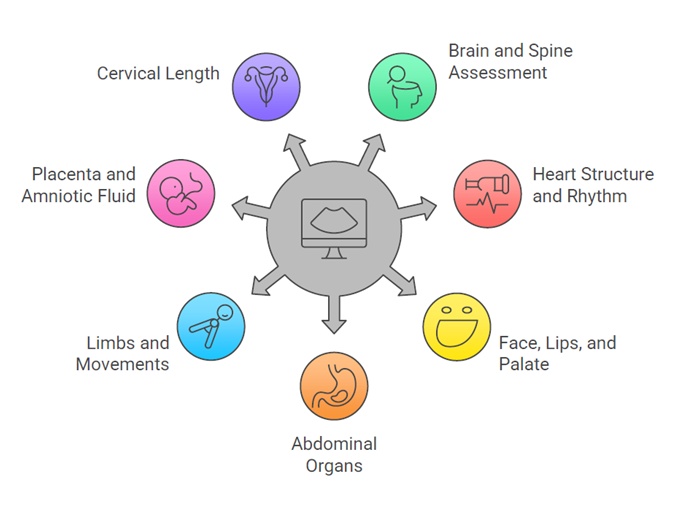
The anomaly scan helps to:
- Assess the baby’s brain and spine
- Examine the heart structure and rhythm
- Evaluate the face, lips, and palate
- Check the stomach, kidneys, bladder, and abdominal wall
- Assess limbs, bones, and movements
- Examine placenta location and amniotic fluid
- Monitor cervical length (if required)
It helps detect most major structural abnormalities at a stage when appropriate planning and management decisions can be made.
Most importantly — in the majority of pregnancies, this scan provides reassuring news.
What Is the Ideal Timing?
The anomaly scan is usually performed between:
18 to 22 weeks of pregnancy
This is the ideal window because:
- Baby’s organs are well developed for detailed evaluation
- There is adequate amniotic fluid for clear imaging
- If any concerns are identified, there is time for further evaluation
Timely scheduling is very important for accurate assessment.
How Is the Scan Done?
The anomaly scan is:
- A detailed abdominal ultrasound
- Completely safe for mother and baby
- Usually takes 30–45 minutes (sometimes longer depending on baby’s position)
During the scan, we carefully examine each organ system in a structured manner. Sometimes, if the baby’s position is not ideal, you may be asked to walk around or come back for a repeat assessment.
The duration depends on clarity and thoroughness — not on speed.
What Abnormalities Can Be Detected?
The anomaly scan can detect many structural conditions, including:
- Brain and neural tube defects
- Congenital heart defects
- Cleft lip or facial abnormalities
- Kidney abnormalities
- Limb abnormalities
- Abdominal wall defects
- Skeletal abnormalities
- Placental abnormalities
Some soft markers that may indicate increased risk for chromosomal conditions can also be identified.
Major ones are
- Ventriculomegaly
- Aberrant right subclavian artery (ARSA)
- Nuchal edema
- Absent nasal bone
Minor ones are
- Echogenic intracardiac focus (EIF)
- Urinary tract dilatation (UTD)
- Single umbilical artery (SUA)
- Hyperechogenic bowel (HEB)
- Short femur/humerus
However, no scan can guarantee 100% detection of all conditions.
What If an Abnormality Is Found?
If something unusual is detected:
- A detailed explanation is provided immediately.
- Further targeted imaging or fetal echocardiography may be advised.
- Additional screening or diagnostic testing may be discussed.
- Multidisciplinary consultation may be arranged if needed.
In certain cases, diagnostic procedures such as Amniocentesis may be recommended to obtain more information.
It is important to remember:
👉 Not every finding means a serious problem.
👉 Some conditions are minor and manageable.
👉 Some findings require monitoring only.
Parents are guided step-by-step with empathy, clarity, and evidence-based advice.
When the Scan Is Normal
A normal anomaly scan is reassuring.
It confirms that the baby’s major organs are developing appropriately and reduces the likelihood of significant structural abnormalities.
Sometimes not all chromosomal/genetic abnormalities cam be detected by Ultrasound alone. The definitive test to rule out chromosomal/genetic syndromes if by invasive testing i.e., Amniocentesis.
Routine follow-up scans for growth and well-being will still be recommended as pregnancy progresses to rule out evolving structural abnormalities.
Is the Anomaly Scan Necessary for All Pregnancies?
Yes. The anomaly scan is recommended for every pregnant woman, regardless of age or risk factors.
Even low-risk pregnancies benefit from this detailed structural evaluation.
Final Thoughts
The anomaly scan is more than just an ultrasound — it is a comprehensive health check for your baby during pregnancy.
It offers:
✔ Detailed structural assessment
✔ Early detection of concerns
✔ Reassurance in most pregnancies
✔ Time for informed decision-making
✔ Coordinated care when required
Every pregnancy deserves careful evaluation and compassionate guidance.
Scheduling your anomaly scan at the right time ensures you receive the clarity and confidence you deserve during this special journey.
If you are between 18 and 22 weeks of pregnancy, consult your Fetal Medicine Specialist to schedule your Anomaly Scan at the right time for a detailed evaluation of your baby’s development. 💛
Anomaly Scan (Level II Scan) – Frequently Asked Questions
1. What is an anomaly scan?
The Anomaly Scan (also called Level II scan) is a detailed ultrasound done between 18–22 weeks of pregnancy to examine your baby’s organs and structures carefully.
2. Is anomaly scan mandatory?
It is strongly recommended for all pregnancies because it detects structural abnormalities that may not be identified earlier.
3. How long does the anomaly scan take?
Usually 30–45 minutes.
Sometimes longer if:
- Baby position is not ideal
- Detailed heart views are needed
- Twin pregnancy
- Additional measurements are required
4. Is the scan painful?
No. It is a routine abdominal ultrasound and completely safe.
5. Can the anomaly scan detect all abnormalities?
No scan can detect 100% of conditions.
However, it detects most major structural abnormalities.
6. Can it diagnose Down syndrome?
It may show soft markers suggestive of chromosomal conditions, but it cannot confirm diagnosis. Diagnostic tests like amniocentesis are required for confirmation.
7. What are soft markers?
Minor ultrasound findings that may slightly increase the risk of chromosomal abnormalities. Most soft markers are harmless when isolated.
8. What if an abnormality is detected?
You will receive:
- Detailed explanation
- Counselling
- Advice regarding further tests (if needed)
- Referral to higher centre (if required)
You will not be left without guidance.
9. Do I need the anomaly scan if my NT scan was normal?
Yes. NT scan and anomaly scan evaluate different aspects of pregnancy. Both are important.